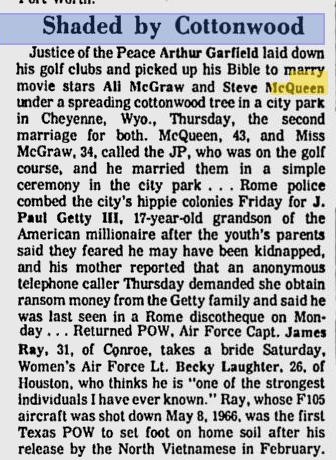
Steve McQueen and Ali McGraw got married in Cheyenne's Holliday Park next to Union Pacific Big Boy 4004. This steam locomotive (they were all called Big Boys, although only a handful still exist), is 132 feet long and weighs 540 tons.
According to Cheyenne legend, Steve McQueen wanted the dateline of their marriage report to read Cheyenne, WY, because thanks to Westerns, everyone knew where Cheyenne was.
Apparently a handful of people every year continue to get married in Holliday Park with Bog Boy as a backdrop.
In addition, Ernest Hemingway and novelist and war reporter Martha Gellhorn married at Cheyenne's Union Depot in November 1940. (I have been in this depot, and I don't recall seeing any kind of reference to this event. I'll have to go check it out.)
Martha Gellhorn
Martha Gellhorn (8 November 1908 – 15 February 1998) was an American novelist, travel writer and journalist, considered by The London Daily Telegraph, among others, to be one of the greatest war correspondents of the 20th century. She reported on virtually every major world conflict that took place during her 60-year career. Gellhorn was also the third wife of American novelist Ernest Hemingway, from 1940 to 1945. At the age of 89, ill and almost completely blind, she committed suicide. The Martha Gellhorn Prize for Journalism is named after her.
Early life
She was born in St. Louis, Missouri, the daughter of Edna (née Fischel), a suffragette, and George Gellhorn, a German-born gynecologist. Her father and maternal grandfather were of Jewish origin, and her maternal grandmother was from a Protestant family. Her brother, Walter Gellhorn, became a noted law professor at Columbia University. Her younger brother, Alfred Gellhorn, an oncologist and former dean of the University of Pennsylvania School of Medicine, died at 94 in 2008.
Gellhorn graduated in 1926 from John Burroughs School in St. Louis and enrolled in Bryn Mawr College in Philadelphia. In 1927, she left before graduating to pursue a career as a journalist. Her first articles appeared in The New Republic. In 1930, determined to become a foreign correspondent, she went to France for two years where she worked at the United Press bureau in Paris. While in Europe, she became active in the pacifist movement and wrote about her experiences in the book, What Mad Pursuit (1934).
After returning to the US, Gellhorn was hired by Harry Hopkins as an investigator for the Federal Emergency Relief Administration. She traveled to report on the impact of the Depression on the United States. Her reports for that agency caught the attention of Eleanor Roosevelt, and the two women became lifelong friends. Her findings were the basis of a collection of short stories, The Trouble I've Seen (1936).
War in Europe
Gellhorn first met Hemingway during a 1936 Christmas family trip to Key West. They agreed to travel in Spain together to cover the Spanish Civil War, where Gellhorn was hired to report for Collier's Weekly. The pair celebrated Christmas of 1937 together in Barcelona. Later, from Germany, she reported on the rise of Adolf Hitler and in 1938 was in Czechoslovakia. After the outbreak of World War II, she described these events in the novel, A Stricken Field (1940). She later reported the war from Finland, Hong Kong, Burma, Singapore and Britain.
Lacking official press credentials to witness the D-Day landings, she impersonated a stretcher bearer and later recalled, "I followed the war wherever I could reach it." She was among the first journalists to report from Dachau concentration camp after it was liberated.
She and Hemingway lived together off and on for four years, before marrying in December, 1940 (Hemingway also lived with his second wife until 1939). Increasingly resentful of Gellhorn's long absences during her reporting assignments, Hemingway wrote her when she left their Finca Vigia estate near Havana in 1943, to cover the Italian Front: "Are you a war correspondent, or wife in my bed?" Hemingway himself, however, would later go to the front just before the D-Day Invasion, and Gellhorn would soon follow, with Hemingway trying to block her travel. When she arrived by means of a dangerous ocean voyage in war-torn London, she told him she had had enough. After four contentious years of marriage, they divorced in 1945.
Later career
After the war, Gellhorn worked for the Atlantic Monthly, covering the Vietnam War, the Six-Day War in the Middle East and the civil wars in Central America. Aged 81, she travelled impromptu to Panama, where she wrote on the U.S. invasion. Only when the Bosnian war broke out in the 1990s did she concede she was too old to go, saying "You need to be nimble."
Gellhorn published numerous books, including a collection of articles on war, The Face of War (1959); a novel about McCarthyism, The Lowest Trees Have Tops (1967); an account of her travels (including one trip with Hemingway), Travels With Myself and Another (1978); and a collection of her peacetime journalism, The View From the Ground (1988).
Peripatetic by nature, Gellhorn reckoned that in a 40-year span of her life, she had created 19 homes in different locales. During a long working life, Gellhorn reported widely from many international trouble-spots.
Political and religious views
Gellhorn remained a committed leftist throughout her life and was contemptuous of those who, like Rebecca West, became more conservative. She considered the ideal of journalistic objectivity "nonsense", and used journalism to reflect her politics.
Gellhorn was a prominent supporter of Israel and the Spanish Republic. For Gellhorn, Dachau had "changed everything", and she became a life-long champion of Israel. She was a frequent visitor to Israel after 1949, and in the 1960s considered moving to Israel. An uncompromising opponent of fascism, Gellhorn had a more ambivalent attitude toward communism. While she is not known to have praised communism and Stalinism, she equally refused to criticize it. She believed in the innocence of Alger Hiss until her death. A self-described "hater", she attacked fascism, anti-communism, racism, Joe McCarthy, Richard Nixon, and Ronald Reagan.
Gellhorn was an atheist. Her part-Jewish parents had embraced secular humanism, and raised Gellhorn as such. Her only quasi-religious instruction consisted of Sunday visits to the Society for Ethical Culture.
Marriages and love affairs
Gellhorn was married twice and had countless lovers, who tended to be married men.
Her first major affair was with the French economist Bertrand de Jouvenel. It started in 1930, when she was 22 years old, and lasted until 1934.
She met Ernest Hemingway in Key West in 1936. They were married in 1940. Gellhorn resented her reflected fame as Hemingway's third wife, remarking that she had no intention of "being a footnote in someone else's life". As a condition for granting interviews, she was known to insist that Hemingway's name not be mentioned.
Gelhorn was unfaithful to Hemingway, having an affair with US paratrooper Major General James M. Gavin, commanding general of the 82nd Airborne Division. Gavin was the youngest divisional commander in the US army in World War II.
Between marriages, Gellhorn had romantic liaisons with "L" Laurence Rockefeller, an American businessman (1945), journalist William Walton (1947), and medical doctor David Gurewitsch (1950). In 1954 she married the former managing editor of Time Magazine, Tom Matthews, and settled down in London, which was to be her home for the rest of her life, although she and Matthews were divorced in 1963.
In 1949, Gellhorn adopted a boy, Sandy, from an Italian orphanage. Although Gellhorn was briefly a devoted mother, she was not a maternal woman. She eventually left Sandy to the care of relatives in Englewood, New Jersey for a long period of time. Sandy endured many absences from Gellhorn during her travels and eventually attended boarding school. He grew to disappoint her, and their relationship became embittered.
In 1972 she wrote:
If I practised sex, out of moral conviction, that was one thing; but to enjoy it ... seemed a defeat. I accompanied men and was accompanied in action, in the extrovert part of life; I plunged into that ... but not sex; that seemed to be their delight and all I got was a pleasure of being wanted, I suppose, and the tenderness (not nearly enough) that a man gives when he is satisfied. I daresay I was the worst bed partner in five continents.
Death
Gellhorn died in London in 1998, aged 89, committing suicide by drug overdose after a long battle with cancer and near total blindness.
Legacy
Gellhorn published books of fiction, travel writing and reportage. Her selected letters were published posthumously in 2006.
On October 5, 2007, the United States Postal Service announced that it would honor five 20th century journalists with first-class rate postage stamps, to be issued on Tuesday, April 22, 2008: Martha Gellhorn; John Hersey; George Polk; Rubén Salazar; and Eric Sevareid. Postmaster General Jack Potter announced the stamp series at the Associated Press Managing Editors Meeting in Washington.
____________
Bibliography
Wyoming Curiosities: Quirky Characters, Roadside Odidities & Other Offbeat Stuff. Dina Mishev.Insider's Guide. 2007.